Keep Out: How a New Generation Learned to Dress Like a Closed Door

There's a version of the fashion conversation that goes like this: clothing is communication, style is self-expression, what you wear tells the world who you are. That version is still true. But it's missing something that's become increasingly visible on American streets, in subway cars, and at the edges of any space where young people gather.
A lot of those fits aren't saying here I am. They're saying stay back.
The Shift From Bridge to Barrier
For most of fashion's modern history, the aspiration was legibility. You dressed to signal your tribe, to invite recognition from the right people, to communicate belonging to a scene or subculture. Punk did it. Hip-hop did it. Skate culture did it. The clothes were a handshake extended to people who understood the reference.
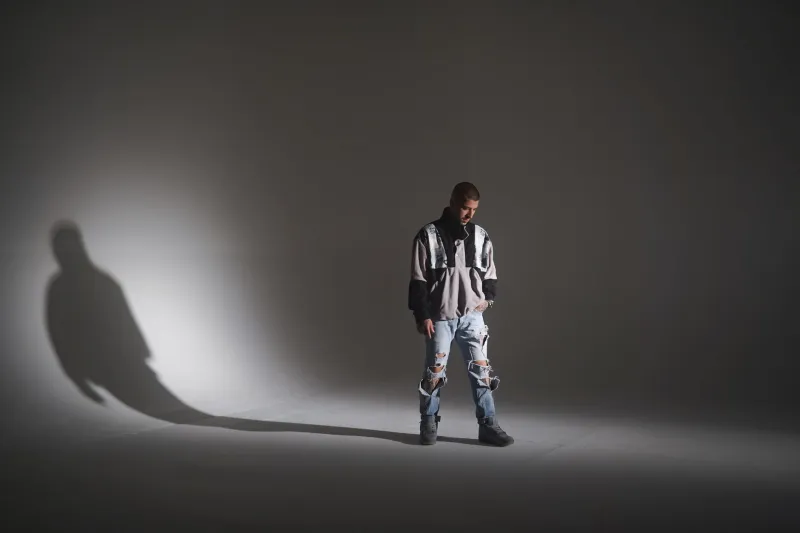
What's happening now is structurally different. The silhouettes are getting larger, more enveloping, more deliberately obscuring. The color palettes are pushing toward absence — black, deep charcoal, washed-out grey, the occasional brutal red that reads as a warning rather than an invitation. The graphics are cryptic or absent entirely. The proportions are wrong in ways that feel intentional, that resist the eye's instinct to settle.
This isn't accidental. It's the aesthetic language of a generation that has decided, with some justification, that being understood by everyone is not actually a goal worth pursuing.
Armor Has Always Been a Design Problem
The techwear movement made this explicit in its function. Garments engineered with load-bearing harnesses, articulated panels, weatherproof shells, and enough pockets to suggest preparedness for conditions nobody has specified — techwear dresses the wearer as someone moving through a hostile environment. The city as terrain. The crowd as obstacle course.
But the armor metaphor extends well beyond technical fabrics. Oversized fits function as physical distancing — they create space between the body and the world, making the wearer's actual shape ambiguous, harder to read, harder to approach. A coat that falls to the ankle, sleeves that swallow the hands, a hood that frames the face without quite revealing it — these are design choices that communicate unavailability.
The deliberately cryptic graphic — the symbol nobody outside a specific community will recognize, the text in a language the viewer probably doesn't read, the imagery that references something obscure enough to exclude casual interpretation — does the same work conceptually. It says: there is a meaning here, and you probably don't have access to it.
This is fashion functioning as a filter.
The Psychology of Opting Out
Why would someone want to dress in a way that repels mainstream acceptance? The easy answer is contrarianism, but that undersells what's actually happening.
Gen Z came of age in a media environment that made visibility both compulsory and dangerous. Social platforms reward legibility — the instantly readable aesthetic, the algorithm-friendly look, the outfit that communicates its vibe in the half-second someone's thumb is hovering over a scroll. Optimizing for that environment means making yourself comprehensible to the largest possible audience. And a lot of young people looked at that deal and decided it wasn't worth taking.
There's also a broader cultural disillusionment at play. Institutions that were supposed to provide belonging — workplaces, communities, even some subcultures — have proven unreliable or actively hostile. When the mainstream consistently disappoints, opting out of its approval systems stops feeling like loss and starts feeling like self-protection.
Clothing becomes the first line of that defense. If the fit makes most people uncomfortable, the people who approach you anyway are already pre-selected. You've outsourced the filtering to your wardrobe.
The Oni Parallel
There's something in this that connects directly to the mythology that runs through Oni Cloth's DNA. The oni — the horned, ferocious figure of Japanese folklore — is not a welcoming presence. It doesn't invite approach. Its power is partly in its capacity to intimidate, to occupy space in a way that makes others reconsider.
But the oni is also deeply individuated. It doesn't look like anything else. It can't be mistaken for something more palatable or mainstream. Its ferocity is inseparable from its identity.
That's the energy a lot of contemporary streetwear is reaching for. Not cruelty. Not actual aggression. But the kind of presence that communicates: I am not here to make you comfortable, and I don't need your approval to exist in this space.
That's not alienation as pathology. That's sovereignty.
The Difference Between Hiding and Refusing
It's worth drawing a line between two things that can look similar from the outside. There's the person who dresses to disappear — to avoid attention, to pass through spaces without being noticed. And there's the person who dresses to refuse — to occupy space on their own terms, to make the terms of engagement clear before anyone opens their mouth.
The oversized silhouette, the intimidating graphic, the deliberately difficult aesthetic — these aren't disappearing acts. They're statements of terms. The wearer is visible. They're just visible on their own conditions.
That distinction matters because it reframes what looks like social withdrawal as something closer to its opposite. Dressing like a closed door isn't about fear of the world. It's about deciding which parts of the world get in.
What the Fit Is Actually Saying
The next time you clock someone in a look that feels deliberately uninviting — the silhouette that swallows the body, the graphics that don't explain themselves, the color palette that refuses to be cheerful — consider what the communication actually is.
It's not I don't care. Caring this much about the specific language of your clothes requires significant investment. It's not I'm antisocial. The most committed practitioners of this aesthetic are often deeply embedded in specific communities — they're just selective about which ones.
It's closer to: I've decided what I'm available for, and I dressed accordingly.
In a culture that constantly pressures everyone to be accessible, legible, and broadly appealing, that's a genuinely radical position. And it's being argued, quietly but clearly, one silhouette at a time.