Less Demon, More Danger: How Japanese Minimalism Is Quietly Outplaying America's Louder-Is-Better Fashion Obsession
There's a particular kind of confidence that doesn't announce itself. It doesn't need to. It walks into a room, occupies it completely, and leaves you trying to figure out exactly what just happened. That's the energy Japanese-inspired minimalism is bringing to American streetwear right now — and it's hitting different than anything a logo tee or a hypebeast drop can offer.
While the dominant conversation in US fashion has long revolved around visibility — who's wearing what brand, how loud the colorway is, how instantly recognizable the silhouette — a quieter counter-movement has been building steadily underneath it all. And it's borrowing its language directly from Japanese design philosophy.
The Problem with Screaming
American fashion loves a statement. From Supreme box logos to rhinestone-encrusted varsity jackets, the cultural default has always leaned toward more. More color, more detail, more branding surface area. And for a long time, that worked. Visibility was currency. If you couldn't be seen, you weren't in the game.
But something happens when everyone is shouting at the same volume — the noise just becomes background. When every hoodie is a billboard and every sneaker is a limited-edition event, the whole system starts to flatten. Nothing stands out because everything is trying to. The maximalist arms race eventually hits a ceiling, and the people who figure that out first tend to be the ones who actually have taste.
That's where minimalist Oni aesthetics come in.
What Minimalist Oni Aesthetics Actually Look Like
The term "minimalist" gets thrown around loosely, so let's be specific about what's actually happening here. This isn't just wearing all black or buying a plain tee and calling it a day. Japanese-inspired minimalism in streetwear operates on a different set of principles entirely.
Negative space is treated as a design element, not an absence of one. A single embroidered oni mask on the inner collar of an otherwise bare jacket carries more weight than a full chest graphic ever could. Monochromatic palettes — deep charcoals, washed blacks, off-whites, and muted earth tones — create a visual stillness that forces the eye to find the details rather than be assaulted by them. The demon motifs are still there, but they're subtle. A small horned silhouette on a sleeve hem. A barely-there print on the back yoke that you only catch in certain light.
The message isn't absent. It's compressed. And compression, it turns out, is a form of power.
Restraint as Rebellion
Here's the thing that makes this movement genuinely interesting: in the context of American fashion culture, choosing restraint is actually the more disruptive move. When the system rewards visibility and excess, opting out of that system entirely is a statement in itself.
Japanese design philosophy has a concept called ma — the idea that emptiness and space are not voids to be filled but elements with their own meaning and presence. Western design traditions have largely treated negative space as a problem to solve. Japanese aesthetics treat it as a tool to wield. When that philosophy gets applied to streetwear, the result is clothing that communicates more by saying less.
For a generation of American consumers who grew up watching brands fight for attention through increasingly extreme tactics, discovering that restraint can be louder than noise is a kind of revelation. It reframes what confidence looks like. You're not trying to be seen. You're choosing what gets seen.
The Brands and Consumers Driving the Shift
This isn't a trend being pushed from the top down by major labels looking for a new aesthetic to monetize. It's coming from smaller, independent brands and from consumers who've genuinely absorbed Japanese design sensibilities — through anime, through travel, through years of paying attention to labels that never bothered with mass-market visibility.
Brands operating in this space tend to share a few characteristics: limited runs, construction-forward design, and a willingness to let a single detail carry an entire piece. They're not competing for shelf space at major retailers. They're building direct relationships with customers who understand the language they're speaking.
On the consumer side, the profile is someone who's moved past the phase of wearing brands as identity proxies. They already know who they are. The clothes don't need to announce it — they just need to reflect it. That's a different relationship with fashion than most American retail culture is built to support, which is exactly why it feels like a rebellion.
Why the Oni Motif Translates So Well
The oni — the horned, fearsome figure from Japanese folklore — is a fascinating symbol to run through a minimalist filter. In maximalist applications, the oni is all fire and fury: full-face mask graphics, aggressive color, intimidation as the primary mode. And that version has its place. But stripped back to its essence, the oni communicates something more nuanced.
The demon isn't just about aggression. It's about transformation, about the boundary between human and something beyond it, about the parts of yourself that don't play by polite rules. When that symbolism is rendered quietly — a small horned outline, a single kanji character, a shadow of a mask worked into a fabric texture — it doesn't lose its edge. It sharpens it. You have to know what you're looking at to understand it, and that exclusivity of comprehension is part of the point.
Wearing a subtle oni reference isn't about hiding what you're into. It's about wearing it for yourself first, and letting everyone else catch up.
What This Means for How You Build a Fit
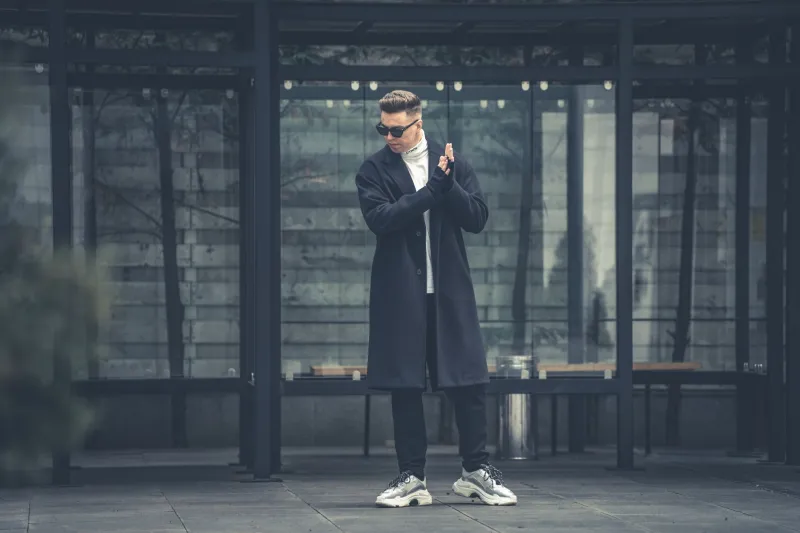
If you're drawn to this direction but not sure how to execute it, the entry point is simpler than you might think. Start by removing rather than adding. A single strong piece — a jacket with an unusual construction detail, a tee with a barely-visible embroidered motif, a pair of pants with an unexpected silhouette — can anchor an entire look without needing backup.
Monochromatic builds are your friend here. Not because they're easy, but because they force you to think about texture, weight, and proportion rather than color contrast. The differences between a matte cotton and a slightly sheen-finished nylon, worn together in the same dark palette, create visual interest without volume.
And resist the urge to explain the fit. That's the whole point. The person who gets it will get it. The person who doesn't isn't the audience.
The Loudest Thing in the Room Isn't Always the Most Powerful
American fashion is slowly learning something that Japanese design culture has understood for decades: presence doesn't require noise. The most commanding thing in a room is often the thing that doesn't seem to be trying at all — but clearly is, on every level that matters.
Minimalist Oni aesthetics aren't a retreat from streetwear's edge. They're a refinement of it. The demon is still there. It's just not performing for you. And somehow, that makes it more unsettling, more interesting, and more real than anything that's been screaming for your attention.
Wear the edge. You don't have to announce it.