Silent Signal: How Your Wardrobe Speaks Before You Ever Open Your Mouth

You walk into a room. Nobody knows your name yet. But they already know something about you.
That's not paranoia — that's psychology. Human beings are wired to read visual cues fast. Before a word leaves your mouth, people are already processing your silhouette, your color palette, the condition of your sneakers, and whether your fit feels intentional or accidental. Style isn't just aesthetic. It's information. And whether you're curating that information or ignoring it, it's still being broadcast.
This is the part most people skip over when they talk about fashion. They get caught up in what's trending, what just dropped, what's getting the most saves on Instagram. But the real conversation — the one that actually matters — is about consistency. About what your clothes say about you every single day, not just on the days you're trying.
The Psychology Behind the First Look
Researchers at Princeton found that people form first impressions in as little as a tenth of a second. That's faster than a blink. And while those impressions are based on a combination of factors — posture, facial expression, energy — clothing plays a massive role in shaping the story before context can fill in the blanks.
Think about it in streetwear terms. Someone who shows up consistently in considered fits — quality fabrics, clean lines, pieces that clearly belong together even when they're not supposed to — reads as someone who pays attention. Someone who cares about the details. And that reputation bleeds into how people treat them professionally, creatively, socially. It's not shallow. It's signal theory in real life.
The flip side is just as true. Erratic dressing — jumping between aesthetics without a through-line, chasing trends without owning them — communicates a different kind of story. Not necessarily a bad one, but a less legible one. And in a world where people are making snap judgments constantly, legibility is power.
Minimalism as a Statement of Confidence
Look at how minimalist dressers move through the world. The person who shows up in a perfectly fitted earth-tone set, clean white tee, and one deliberate accessory isn't trying to impress anyone — and that's exactly why they do. Restraint communicates confidence. It says: I know who I am, and I don't need volume to prove it.
In Japanese fashion culture — something deeply embedded in what we do at Oni Cloth — this philosophy has a name: ma, the concept of meaningful negative space. What you leave out is as important as what you put in. A minimalist wardrobe, built with intention, creates a consistent visual identity that people recognize and remember. You become the person in the room who always looks like themselves.
And that consistency? That's credibility. In creative industries especially, people who have a clear aesthetic point of view are taken more seriously. Stylists, directors, designers, photographers — they're all building a visual language, and the people they collaborate with are often selected based on whether their personal aesthetic aligns. Your wardrobe is your portfolio before your portfolio ever comes out.
Maximalism as a Deliberate Power Move
But let's not pretend restraint is the only road to a strong reputation. Maximalism, done with conviction, hits just as hard.
Think about the cultural figures who've built entire identities around going big — layering prints, stacking accessories, mixing references in ways that shouldn't work but absolutely do. The key word there is conviction. The difference between someone who looks like they got dressed in the dark and someone who looks like they engineered a masterpiece from chaos is intentionality. One is noise. The other is a statement.
Maximalist dressers who do it right — who have a consistent internal logic to their outfits even when the external appearance looks wild — build reputations as creative forces. They're the people in the room who make things interesting. Who bring energy. Whose presence shifts the atmosphere. That's not an accident. That's a wardrobe doing its job.
The Hybrid Identity: Where Streetwear Gets Interesting
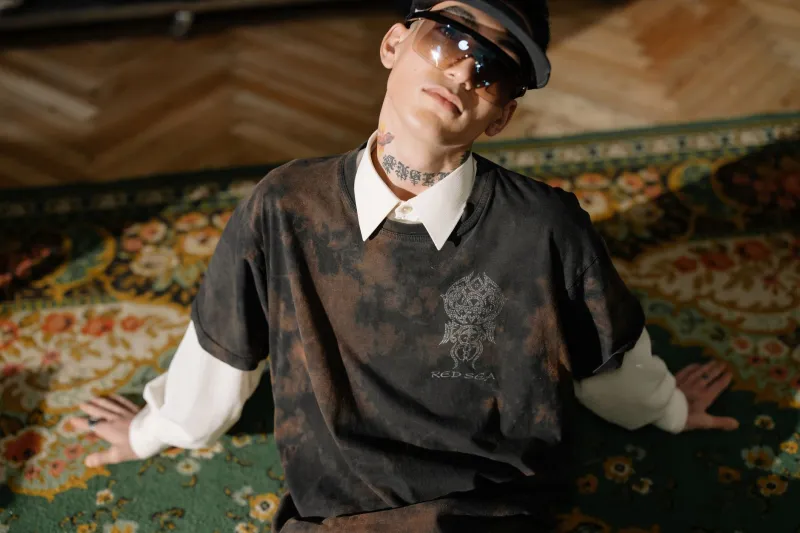
A lot of the most interesting dressers right now are operating in the hybrid space — pulling from both ends of the spectrum depending on context without ever losing their core identity. A structured Japanese workwear jacket over a graphic tee. Technical trousers paired with a worn-in vintage crewneck. The kind of fits that feel simultaneously polished and raw.
This hybrid approach is where contemporary streetwear is living right now, and it's also where personal branding through fashion gets genuinely complex. Because the people who can move between contexts — who can show up at a gallery opening and a skate spot and look like themselves in both places — are the ones who've really figured out who they are. The wardrobe isn't a costume. It's an extension.
Building a Reputation, One Fit at a Time
So how do you actually use this? How do you go from dressing reactively to dressing with intention?
Start with anchors. Identify three to five pieces that feel undeniably you — pieces you reach for instinctively, that fit right, that work in multiple contexts. Those are your foundation. Everything else you add should relate back to them in some way, whether through color, texture, silhouette, or vibe.
Then get consistent. Not boring — consistent. There's a difference. Consistency means people can predict the general energy of how you show up without being able to predict the exact outfit. It means your style has a signature. And signatures are what get remembered.
Finally, invest in quality over quantity. One piece that's genuinely excellent — well-constructed, meaningful, built to last — does more for your reputation than ten pieces that are just fine. People notice the difference, even when they can't articulate why. The quality of your clothes communicates the quality of your standards.
The Oni Standard
At Oni Cloth, we talk a lot about wearing the edge. But the edge isn't just about looking sharp — it's about looking intentional. The oni mask in Japanese mythology represents something that can't be ignored, something that commands attention and respect before it ever speaks. Your wardrobe can do the same thing.
Your fit is already talking. The only question is whether it's saying what you mean.
Dress like you mean it. Every day. That's how the reputation gets built.